Artificial Intelligence is no longer a competitive advantage reserved for large enterprises—it has become a prerequisite for long-term competitiveness. SMEs that continue relying on traditional processes risk falling behind organizations that use AI to automate operations, improve decision-making, reduce costs, preserve organizational knowledge, and deliver more responsive customer experiences.
The greatest opportunity is not simply adopting AI tools, but re-engineering business processes through Agentic RAG, AI Agents, and Multi-Agent Systems. These technologies enable intelligent assistants that understand company-specific knowledge, collaborate across business functions, retrieve trusted information, and autonomously execute tasks under human supervision. Rather than replacing employees, they augment human expertise and free teams to focus on higher-value activities.
Today, this transformation is more accessible than ever thanks to the maturity of the Free and Open Source Software (FOSS) ecosystem. SMEs can rapidly develop Minimum Viable Products (MVPs) and move quickly into production using low-code, Dockerized platforms, significantly reducing implementation time, investment costs, and dependence on proprietary software vendors.
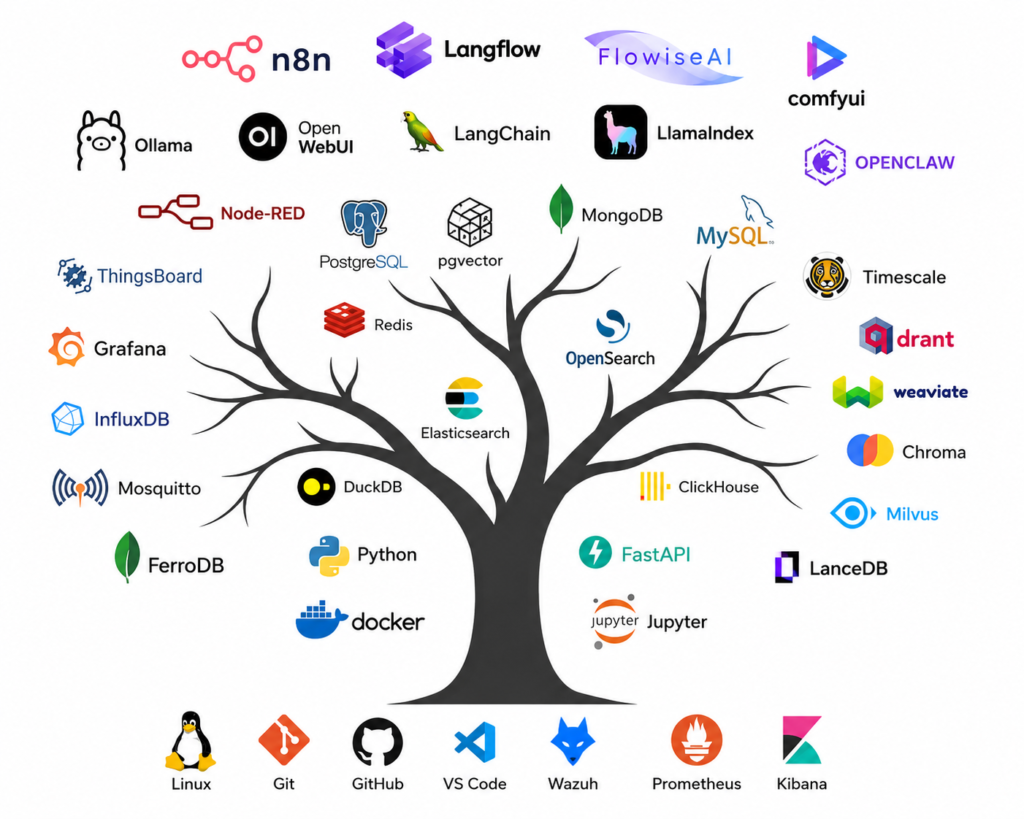
This ecosystem includes powerful building blocks such as n8n, Langflow, Flowise, and ComfyUI for AI workflow orchestration and agent development; Ollama for securely deploying open-source AI models on local infrastructure; Node-RED, ThingsBoard, and Grafana for integrating AI with IoT devices, industrial automation, and operational monitoring; OpenClaw for autonomous computer-use and task execution; and enterprise-grade data platforms such as PostgreSQL, MongoDB, and modern vector databases that power Retrieval-Augmented Generation (RAG) and enterprise knowledge management.
By combining these technologies with local or hybrid deployments, SMEs can build secure AI assistants while ensuring data sovereignty, protecting sensitive information, complying with regulatory requirements, avoiding vendor lock-in, lowering operating costs, and retaining full ownership of their knowledge and intellectual property. Hybrid architectures also allow organizations to leverage low-cost cloud models for non-sensitive workloads while keeping confidential business data within their own infrastructure.
The result is a practical and affordable path for SMEs to move from concept to production in weeks rather than months, creating intelligent digital workers that continuously improve business processes and establish a sustainable competitive advantage. The question is no longer whether SMEs should embrace AI, but how quickly they can redesign their operations around secure, open, and autonomous AI systems before their competitors do.