
Peak Shaving & Smart Energy Management
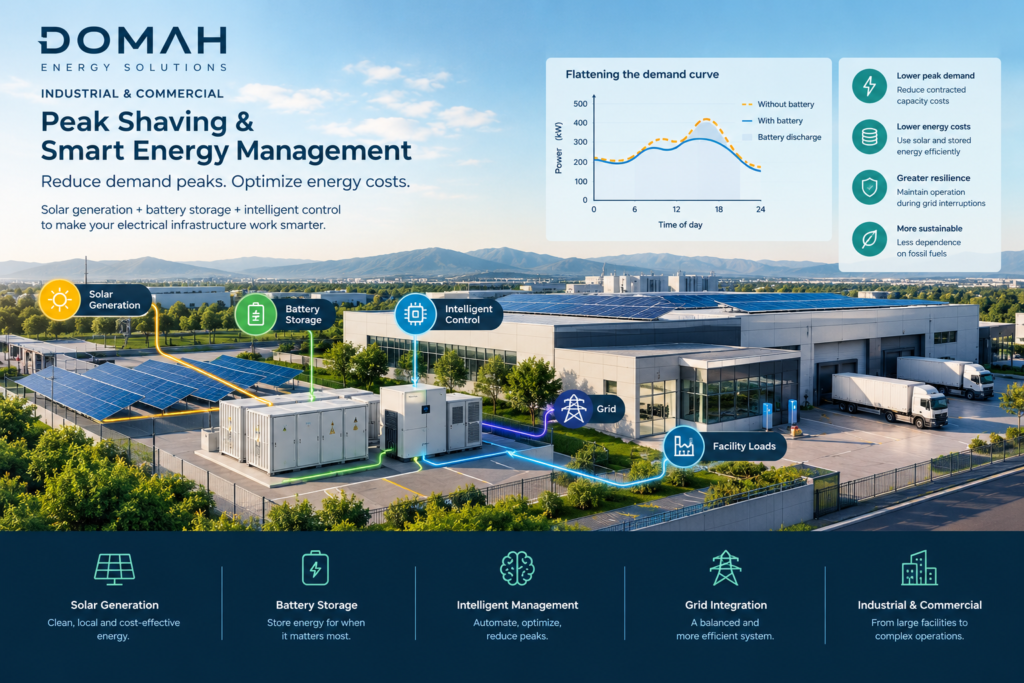
Reduce demand peaks. Optimize energy costs. Make better use of your power infrastructure.
For industries, commercial facilities and large electricity users, reducing energy consumption is only part of the equation.
Electricity costs can also depend significantly on how much power a facility demands at its peak.
A photovoltaic system can substantially reduce the amount of energy purchased from the grid, but solar generation is limited to daylight hours. If the facility’s highest demand occurs at another time, solar generation alone may not reduce the peak power that determines part of the electricity bill.
This is where solar generation, battery storage and intelligent demand management work together.
From Energy Saving to Demand Management
Traditional energy efficiency focuses primarily on reducing kWh consumed.
Peak shaving introduces another dimension:
How much power does your facility require at any given moment?
Electrical infrastructure must be capable of supplying the facility’s maximum instantaneous demand. In many commercial and industrial tariffs, this capacity can represent a significant component of the electricity bill.
A facility may therefore consume a relatively moderate amount of energy while still generating a high electricity cost because of occasional demand peaks.
Peak shaving turns battery storage into a financial and operational tool:
Instead of allowing short periods of high demand to determine the required grid capacity, the battery supplies part of that demand when the peak occurs.
How Peak Shaving Works
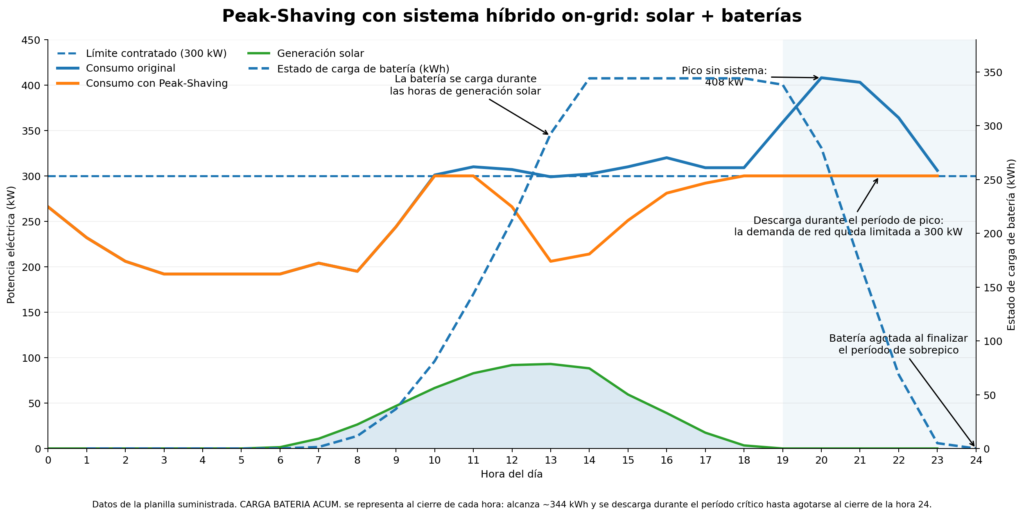
A hybrid on-grid system combines:
Solar Generation
During daylight hours, photovoltaic panels generate electricity that can be used directly by the facility.
Any available surplus can be stored in the battery system.
Battery Storage
The battery stores energy and makes it available when it provides the greatest operational or economic value.
Depending on the operating strategy, the battery may also be charged from the grid when electricity prices or operating conditions make this advantageous.
Intelligent Control
The energy management system continuously monitors the facility’s demand and controls battery charging and discharging.
When demand approaches a predefined power threshold, the battery automatically supplies part of the required power.
The grid therefore sees a lower and flatter demand profile.
Flattening the Demand Curve
Imagine a facility whose electrical demand occasionally reaches 400 kW, while its target grid demand is 300 kW.
Instead of allowing the grid to supply the entire 400 kW during the peak, the battery can provide the additional 100 kW required during that period.
The facility still uses the energy it needs.
But the grid sees approximately:
300 kW instead of 400 kW
The result is a significantly flatter net demand curve and potentially lower capacity-related electricity costs.
The Key Is Not Just Battery Capacity
One of the most important aspects of peak-shaving system design is understanding the difference between power and energy.
kW determines how much peak you can reduce.
The inverter and battery power determine how much instantaneous demand the system can offset.
kWh determines how long you can sustain the reduction.
Battery capacity determines how long the system can continue supplying that additional power.
For example, a system may have enough energy capacity to operate for several hours, but if its inverter cannot deliver sufficient power, it will not be capable of cutting a large demand peak.
Peak shaving therefore requires simultaneous optimization of power and storage capacity.
Solar + Storage + Intelligent Demand Management
The real value comes from combining the three functions.
Solar generation
reduces energy purchased from the grid and provides energy for charging the battery.
↓
Battery storage
moves available energy from periods of generation to periods of high demand.
↓
Intelligent control
determines when the battery should charge and discharge to maintain the desired grid-demand threshold.
↓
Lower and more predictable grid demand
This transforms the battery from a passive storage device into an active energy-management asset.
More Than Peak Shaving
Once battery storage and intelligent control are integrated into the electrical infrastructure, the same system can support multiple objectives.
Peak Shaving
Limit maximum grid demand and reduce capacity-related costs.
Solar Self-Consumption
Use locally generated solar energy instead of purchasing equivalent energy from the grid.
Energy Time Shifting
Store energy when it is available and use it later when required.
Demand Optimization
Manage the relationship between generation, storage and facility consumption.
Grid Resilience
Provide an additional energy resource during grid interruptions when the system is designed to support backup operation.
Future Electrification
Provide additional flexibility as facilities introduce new electrical loads such as electric vehicles, HVAC systems or other high-power equipment.
A Real Economic Opportunity
The economic case for peak shaving depends on the facility’s tariff structure, demand profile and operating schedule.
As an illustrative example from the analysis underlying this solution, reducing contracted peak demand could give us the opportunity to pay off the investment in about 5 years, with an estimated life cycle of the investment of no less than 20 years for panels and more than 10 years for battery banks.
Designed Around Your Load Profile
Peak shaving is not a one-size-fits-all product.
DOMAH analyzes the facility’s actual energy behavior to determine:
- maximum demand
- demand profile over time
- contracted capacity
- tariff structure
- solar generation potential
- battery power requirements
- battery energy capacity
- critical loads
- operating schedules
- potential future electrical loads
The objective is to determine how many kW need to be controlled and how many kWh are required to control them for the necessary duration.
This allows the system to be designed around the economics and operational requirements of the facility rather than around a predefined equipment package.
Modular Energy Infrastructure
The system can be developed as a modular architecture combining:
PV Generation
↓
Hybrid Inverter
↓
Battery Storage
↓
Energy Management System
↓
Facility Loads + Grid
Additional infrastructure can be integrated where required, including:
Grid connection · Backup generator · Automatic transfer system · EV charging · IoT monitoring · Building management · Industrial systems
The underlying system architecture described in the source document includes an on-grid solar system, generator, automatic transfer system and battery bank.
Intelligent Energy Management
At DOMAH, we see energy storage as part of a broader digital infrastructure.
The battery can be connected to monitoring, automation and IoT systems to create a more comprehensive energy-management platform.
This opens the door to progressively more sophisticated strategies:
Monitor
Understand how energy is generated and consumed.
Analyze
Identify demand peaks, inefficient operating patterns and optimization opportunities.
Predict
Anticipate demand and energy availability.
Control
Automatically manage battery charging, discharging and other controllable loads.
Optimize
Continuously adjust the strategy according to operational and economic conditions.
Energy becomes something you can measure, manage and optimize — not simply consume.
Engineering the Right Solution
The objective is not to install the largest possible battery.
It is to install the right combination of generation, power and storage capacity to achieve a defined operational and economic objective.
DOMAH combines energy engineering with automation, IoT, software integration and data management to create solutions adapted to each facility.
We design around your demand — not around a catalogue.
Turn Your Battery Into an Energy Management Asset
A battery can be much more than backup power.
It can become a strategic component of your electrical infrastructure:
Generate when solar energy is available.
Store when energy is abundant.
Discharge when demand reaches critical levels.
Keep grid demand within the desired threshold.
Optimize the way your facility consumes energy.
Reduce peaks. Reduce costs. Increase control.
DOMAH Peak Shaving Solutions
Intelligent energy storage for industrial and commercial power management.
Solar generation + battery storage + intelligent control
designed to reduce demand peaks, optimize energy costs and transform your electrical infrastructure into an actively managed energy system.
Request an Energy Assessment: About