
This article introduces augmented co-creation, a methodological proposal developed by DOMAH SA for process reengineering assisted by generative artificial intelligence (AI). The approach combines agile development principles, iterative management practices inspired by Scrum, participatory design, and a sociotechnical perspective. Its proposed contribution is to integrate workforce learning, the formalization of domain knowledge, assisted prototyping, and information governance within each work cycle. It adopts a dual criterion for success: process performance and the organizational capabilities acquired. The article then considers its application to the public sector, where additional requirements of legality, traceability, equal access, data protection, and public value apply. The paper describes an intervention model and evaluation criteria; it does not claim that the methodology has already been empirically validated.
1. Introduction: from assisted redesign to institutional capability
Process reengineering examines how work is performed, where friction arises, and which changes could improve outcomes. Traditionally, specialist teams translated the knowledge of people performing the work into models, procedures, and systems. That exchange remains essential; the new possibility is that generative AI tools can assist documentation, the exploration of alternatives, specification, and some prototyping tasks. Technical possibility, however, is not equivalent to actual improvement: errors, complex integrations, and decisions affecting people’s rights require specialist controls (NIST, 2023; Autio et al., 2024).
DOMAH’s working hypothesis is that deliberately integrating training, process knowledge, and assisted development can turn the user team into an active participant in solutions rather than a mere source of requirements. This expanded agency transforms a consulting project into a collective learning experience. The desired outcome is not confined to automation or savings: it includes intelligible processes, improved services, and a stronger capacity for future adaptation.
This paper sets out a conceptual framework and an operational sequence to test that proposal. It is not an experimental evaluation, nor does it attribute DOMAH’s specific methodology to Agile, Scrum, or the other authors cited.
2. Theoretical foundations and conceptual boundaries
The Agile Manifesto (Beck et al., 2001) prioritizes individuals and interactions, customer collaboration, working software, and responding to change. These values do not remove processes, documentation, or planning: they establish relative priorities for learning more quickly and generating value. Augmented co-creation extends this orientation to organizational redesign projects, where the “product” may encompass processes, rules, integrations, dashboards, and digital systems.
Scrum is a specific framework for addressing complex problems through empiricism, self-managing teams, and iterative cycles. The 2020 Scrum Guide defines accountabilities, events, artifacts, and commitments; simply calling a work period a “sprint” does not establish that Scrum is being used in its strict sense (Schwaber & Sutherland, 2020). DOMAH’s model therefore draws on Scrum-inspired practices—prioritized backlogs, iteration planning, increment reviews, and retrospectives—and proposes adopting full Scrum only when its conditions and accountabilities are appropriate.
Participatory design calls for the people who will use a technology to take part in shaping and evaluating it (Schuler & Namioka, 1993). Sociotechnical systems research reminds us that tools cannot be assessed apart from work, social relationships, and organizational arrangements (Trist & Bamforth, 1951). The methodology adopts both perspectives: people contribute situated knowledge and acceptance criteria; technology offers new ways to represent and test alternatives; and the organization defines responsibilities and boundaries.
The notion of the prosumer (Toffler, 1980; Ritzer & Jurgenson, 2010) can help describe user participation in activities once reserved for producers. Service-dominant logic emphasizes relationships and processes of value co-creation (Vargo & Lusch, 2004). These approaches offer fruitful analogies, but they do not demonstrate the effectiveness of any particular AI-assisted development methodology. “Augmented co-creation” is used here as the name of DOMAH SA’s proposal, which requires empirical testing in clearly defined organizational contexts.
3. Definition and components of augmented co-creation
Augmented co-creation is defined as a participatory reengineering model in which domain experts, methodological and technical specialists, and generative AI tools work iteratively to understand problems, redesign processes, and deliver verifiable solutions. The organization does not delegate judgment to a model: it retains authority over objectives, priorities, acceptance conditions, and deployment.
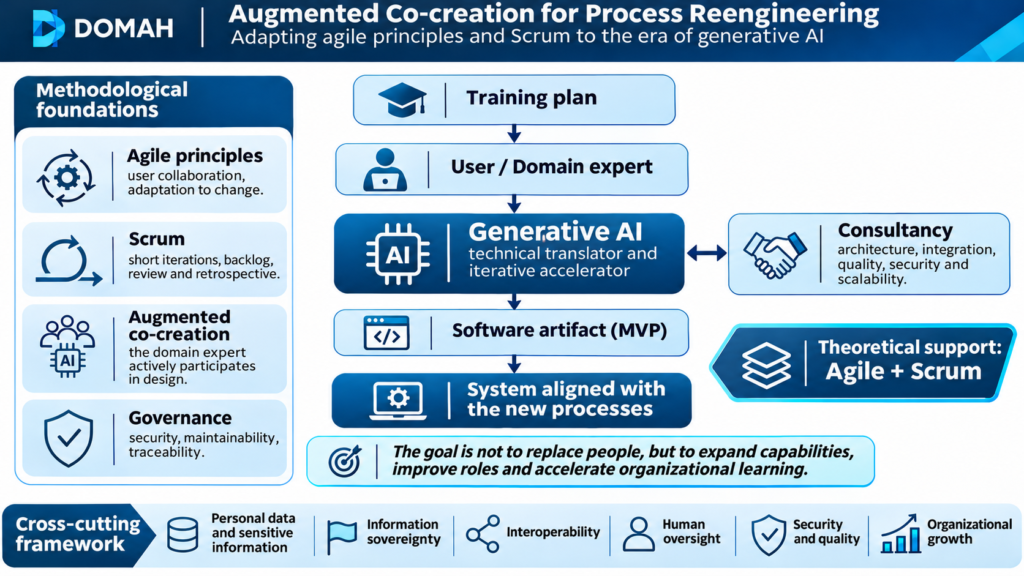
The approach comprises three connected dimensions. Hybrid agency distributes tasks among the people who understand the process, AI that assists translation, and the team that ensures quality and feasibility. Semantic abstraction turns tacit knowledge into understandable descriptions, rules, exceptions, and tests without assuming that conversational interfaces replace rigorous analysis. Co-creation governance provides versioning, permissions, interoperability, code review, and accountability for results.
Figure 1 illustrates this distribution of functions within a cross-cutting governance framework. It is deliberately conceptual: it does not depict a purely linear execution flow or imply that every assisted prototype automatically becomes production-ready.
4. Operationalization: two learning cycles in one intervention
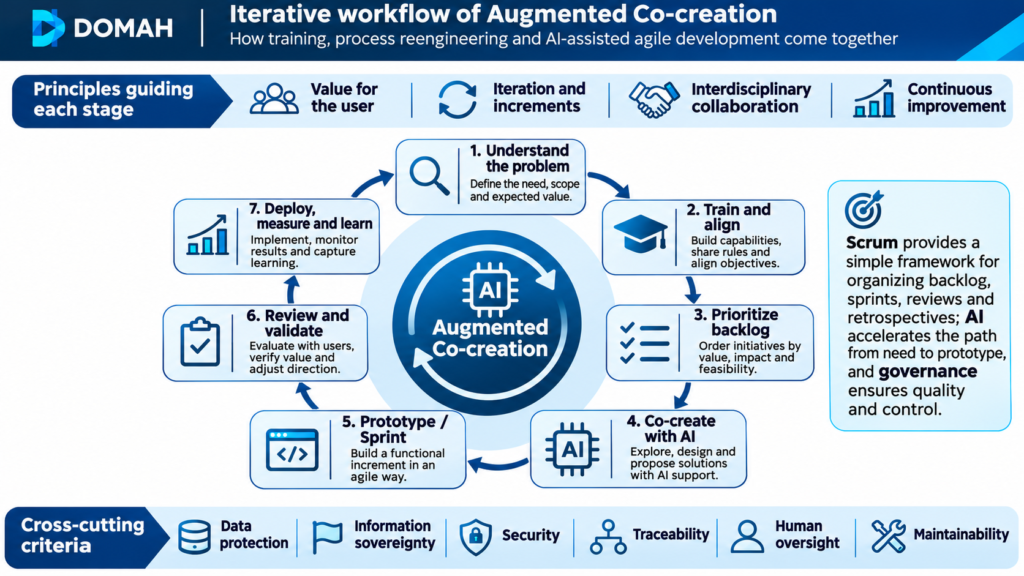
The proposal integrates an organizational learning cycle—understanding, abstracting, comparing, and improving—with an incremental delivery cycle—prioritizing, prototyping, verifying, integrating, and measuring. The two inform one another: when a prototype exposes an exception, it improves process understanding; when a team learns to specify requirements better, it improves subsequent increments. Not every iteration requires writing code: the right outcome may be simplifying a rule or integrating an existing system.
The stages in Figure 2 represent an indicative and reversible sequence rather than a rigid waterfall process. Each stage should generate minimal evidence, named responsibilities, and explicit decisions on data handling and risks.
The organization identifies sponsorship and process ownership; its experts provide rules and validate outcomes. Facilitators and consultants support workshops, architecture, development, testing, and knowledge transfer. Security, data, and compliance teams participate from the initial framing of each use case. AI functions as an assistive tool: it is not granted autonomous authority over people, rights, or critical deployments.
5. A differentiated application to the public sector
In the public sector, efficiency and learning objectives must be situated within legality, administrative continuity, equal treatment, transparency, and accountability. A process may become faster without delivering a better service if it excludes users, hides criteria, or transfers risks to those who need assistance. Public data ethics requires the collective interest and institutional integrity to guide information use (OECD, 2021).
The adaptation is more than a change in terminology: the domain expert is often a public servant familiar with case files, regulations, and exceptions; governance stakeholders include authorities, legal teams, data stewards, technology departments, and oversight bodies; and success criteria incorporate service quality and the exercise of rights. Figure 3 highlights these specific elements and their relationship to the general methodological foundations.
Consider a municipal streetlighting complaints process. The assessment reconstructs intake channels, records, routing, inspections, repairs, and closure communication. A group of public workers and managers identifies bottlenecks and exceptions; the backlog prioritizes improvements by impact and feasibility; a prototype could assist request classification or tracking, always subject to human validation before affecting services. This is an illustrative use case, not an observed result from any particular municipality.
Citizen communications may use service information to notify a complainant that their case has been resolved or a resident that works affect their area, provided there is a legitimate purpose, sufficient legal basis, minimization, and transparency. The mere availability of multiple public databases does not authorize their indiscriminate combination or the creation of political or sensitive profiles. Service personalization must not become surveillance, discrimination, or opaque microtargeting.
In Figure 4, regulatory mapping and legal validation appear explicitly in the workflow. These controls accompany every iteration even though the graphic also highlights them as dedicated validation points.
6. Discussion and conclusion
Augmented co-creation is more than a technique for AI-assisted code generation: it proposes integrating incremental delivery and organizational knowledge creation under explicit governance rules. Its relationship to Agile, Scrum, and participatory design is conceptual and operational; it should not be confused with certification of full Scrum implementation or with an already validated theory. Its distinctiveness lies in the proposed combination, and its usefulness must be demonstrated through documented projects.
For private organizations, the expected outcome is a stronger ability to solve problems and evolve processes without losing control of critical information. For the State, a public-value requirement is added: better services, legitimate uses of data, continuity, and stronger public capabilities. In both contexts, transformation is more durable when it leaves two inseparable results: processes that work better and people who can keep improving them.
References
Beck et al. (2001). Manifesto for Agile Software Development. https://agilemanifesto.org/
Schwaber, K., & Sutherland, J. (2020). The Scrum Guide: The Definitive Guide to Scrum. https://scrumguides.org/scrum-guide.html
Schuler, D., & Namioka, A. (Eds.). (1993). Participatory Design: Principles and Practices. Lawrence Erlbaum. https://www.routledge.com/Participatory-Design-Principles-and-Practices/Schuler-Namioka/p/book/9780203744338
Trist, E. L., & Bamforth, K. W. (1951). Some social and psychological consequences of the longwall method of coal-getting. Human Relations, 4(1), 3–38. https://doi.org/10.1177/001872675100400101
Toffler, A. (1980). The Third Wave. William Morrow.
Ritzer, G., & Jurgenson, N. (2010). Production, consumption, prosumption. Journal of Consumer Culture, 10(1), 13–36. https://doi.org/10.1177/1469540509354673
Vargo, S. L., & Lusch, R. F. (2004). Evolving to a new dominant logic for marketing. Journal of Marketing, 68(1), 1–17. https://doi.org/10.1509/jmkg.68.1.1.24036
NIST. (2023). Artificial Intelligence Risk Management Framework (AI RMF 1.0). https://www.nist.gov/itl/ai-risk-management-framework
Autio, C., et al. (2024). AI RMF: Generative Artificial Intelligence Profile (NIST AI 600-1). https://doi.org/10.6028/NIST.AI.600-1
Open Source Initiative. (2024). Open Source AI Definition, version 1.0. https://opensource.org/ai/open-source-ai-definition
OECD. (2021). Good Practice Principles for Data Ethics in the Public Sector. https://doi.org/10.1787/caa35b76-en
Argentina. (2000). Ley 25.326 de Protección de los Datos Personales. Referencia nacional, cuya aplicabilidad depende del caso. https://www.argentina.gob.ar/normativa/nacional/ley-25326-64790/texto