
Turning a threat into a strategic opportunity for Argentina’s development
Artificial intelligence and software are no longer merely productivity tools: they are strategic infrastructure. Just as national competitiveness in the twentieth century depended on control over energy and natural resources, in the twenty-first century it will also depend on the ability to develop, control, and benefit from data, algorithms, and digital infrastructure. International experience shows that open-source software and open AI are now tools of industrial policy, innovation, and economic development. Argentina has the talent, institutions, and ecosystem needed to turn this opportunity into a long-term national policy.
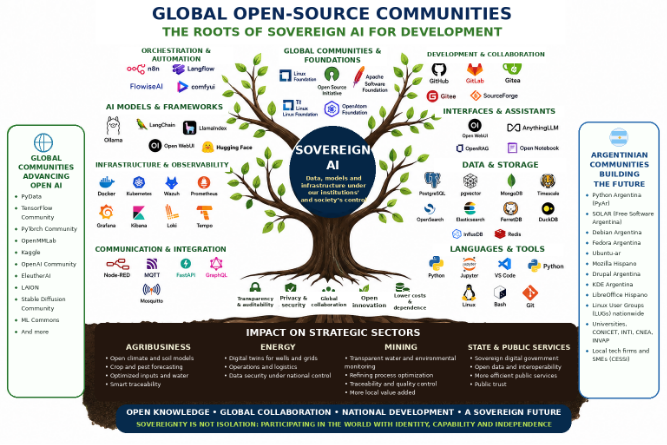
The world is moving toward greater technological sovereignty
In recent years, major economies have increasingly treated software and artificial intelligence as strategic assets.
China is one of the most visible examples. In response to growing international technology restrictions, it has pursued a strategy to strengthen its autonomy by developing domestic platforms such as Gitee, establishing the OpenAtom Foundation, and supporting openly available AI models developed by companies such as Alibaba (Qwen) and DeepSeek. Released under open-weight arrangements, these models achieve highly competitive results on numerous international benchmarks and can substantially reduce the cost of AI adoption.
Europe is moving in a similar direction through Gaia-X, an initiative intended to safeguard European data sovereignty, while the EuroHPC program builds domestic capabilities in supercomputing and artificial intelligence.
Since the early 2000s, Brazil has promoted free and open-source software in public agencies, supporting interoperability, lower costs, and stronger domestic technology companies.
India, Japan, and South Korea also promote policies based on open standards and their own digital infrastructure, recognizing technological autonomy as an increasingly important factor in economic competitiveness.
The common thread is clear: none of these countries aims for technological isolation. Instead, they seek to build their own capabilities to reduce strategic dependencies and strengthen innovation.
A possible agenda for Argentina
Argentina is especially well positioned to pursue a similar path.
The country has excellent public universities, an established scientific system, internationally active technology companies, and highly skilled human resources.
A national strategy based on open technologies could accelerate digital transformation in strategic productive sectors.
Agribusiness
Integrating data from INTA, universities, and provincial agencies could support open models for weather forecasting, yield estimates, optimized fertilizer use, and the early detection of pests with AI.
Energy
In Vaca Muerta, collaborative development of open digital twins could improve reservoir simulations, optimize operations, and keep strategic geological information under national control.
Mining
In lithium and copper production, open algorithms could optimize industrial processes, improve water efficiency, and strengthen environmental monitoring with tools auditable by public agencies, universities, and scientific communities.
The benefits go far beyond savings on software licenses: they include developing domestic knowledge, creating skilled jobs, strengthening national companies, and reducing technological dependence in critical sectors.
The foundations are already here
Argentina already has much of the ecosystem needed to pursue a national policy of technological sovereignty.
The Python Argentina community (PyAr) is among the most active in Latin America and has participated in international free-software and AI projects for more than twenty years.
Organizations such as SOLAR (Software Libre Argentina) have promoted the adoption of open standards and the development of domestic capabilities for decades.
Communities such as Debian Argentina, Fedora Argentina, Ubuntu-ar, Mozilla Hispano, Drupal Argentina, KDE Argentina, and numerous Linux User Groups remain actively engaged in development, training, and international collaboration.
The country also has a scientific system comprising national universities, CONICET, INTI, CNEA, and INVAP, with recognized research groups in AI, robotics, numerical simulation, image processing, and high-performance computing.
The private sector is another distinctive strength. Unicorns, medium-sized, small, micro-, and even one-person businesses, organized in industry associations and informal communities, share knowledge and participate actively in local and international free and open-source software communities.
Argentina does not need to build a technology ecosystem from scratch. Much of the necessary capacity already exists. The challenge is to connect it through public policies that promote cooperation among government, universities, the scientific system, companies, and free-software communities.
A development policy, not merely a technology policy
Technological sovereignty does not mean replacing all foreign technology or shutting the country off from the world.
It means building national capabilities to make decisions, innovate, and compete on equal terms.
Every peso invested in open-source software, artificial intelligence, and local development remains in the national economy in the form of knowledge, highly skilled employment, and productive innovation.
International experience shows that leading digital economies have combined global cooperation with stronger domestic capabilities. For Argentina, advancing a national open-technology ecosystem is a concrete opportunity to increase competitiveness, add value to strategic resources, and consolidate a knowledge-based development policy.
Institutional references
- OpenAtom Foundation — https://www.openatom.org
- Gitee — https://gitee.com
- Hugging Face — https://huggingface.co
- Qwen (Alibaba) — https://qwen.ai
- DeepSeek — https://www.deepseek.com
- Gaia-X — https://gaia-x.eu
- EuroHPC Joint Undertaking — https://eurohpc-ju.europa.eu
- Argentine Software Industry Chamber (CESSI) — https://www.cessi.org.ar
- Python Argentina — https://www.python.org.ar
- Argentina Open Data — https://datos.gob.ar
- INTA — https://www.inta.gob.ar
- CONICET — https://www.conicet.gov.ar
Academic references
- Benkler, Y. (2006). The Wealth of Networks. Yale University Press.
- Chesbrough, H. (2003). Open Innovation. Harvard Business School Press.
- Mazzucato, M. (2013). The Entrepreneurial State. Anthem Press.
- OECD (2024). Digital Economy Outlook.
- European Commission (2020). A European Strategy for Data.
- Linux Foundation Research (2024). The Economic Value of Open Source Software.